Four people. A sealed room. No fresh air. The CO₂ passes the 8-hour workplace limit before sunrise, and nobody wakes up gasping. This manual gives you the numbers, the failures and the backups for every system that keeps a sealed room alive.
Get the Manual — $27153 pages + 2 bonuses · instant PDF
A lot of "air quality" gadgets guess it from other gases and show a calm, official-looking number while the air goes bad.
One setting buried in the menu, on by default, drifts it hundreds of ppm low in a sealed room. In the comfortable direction.
Nobody measured at the outlet. The number on the box isn't the number in the room.
Gasoline goes stale in months and gums up the carburetor. The day you need it is the day it won't start.
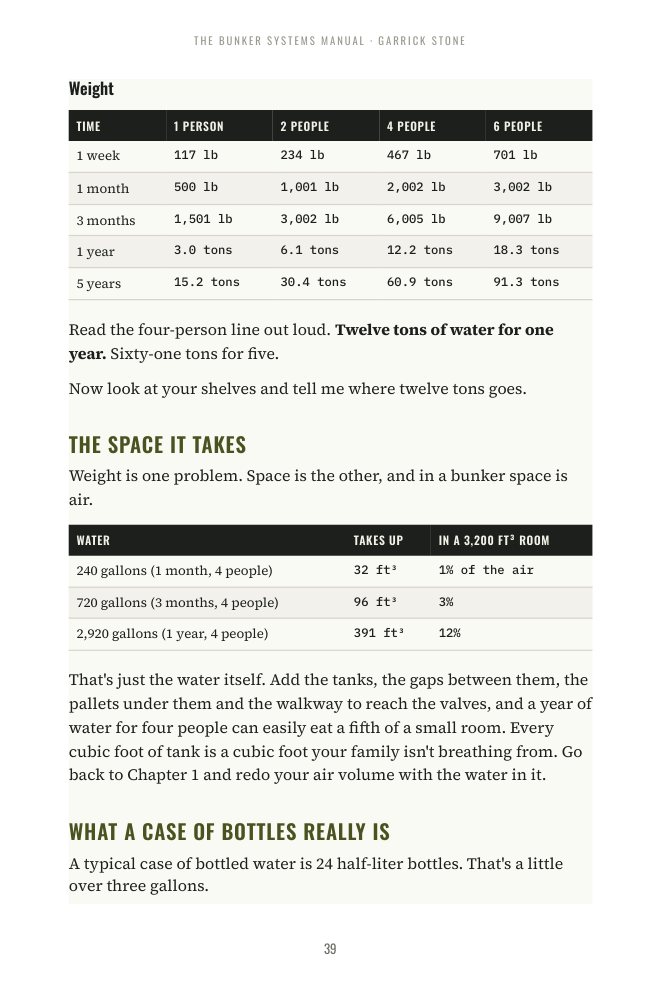
One year for four people is about 900 cases. Twelve tons. On a floor you've never checked.
Shelves tight against the wall, cardboard boxes, and mold growing behind them all season.
Calories on the shelf aren't food until you can grind, cook and eat them on rationed power.
If something lands on it, you don't have a shelter. You have a room you can get trapped in.
Every one of these looks fine the day you count your shelves. Every one of them shows up at two in the morning.
I'm not saying that to scare you. I'm saying it because I did the math, out loud, one number at a time. Here are three of the numbers from the manual.
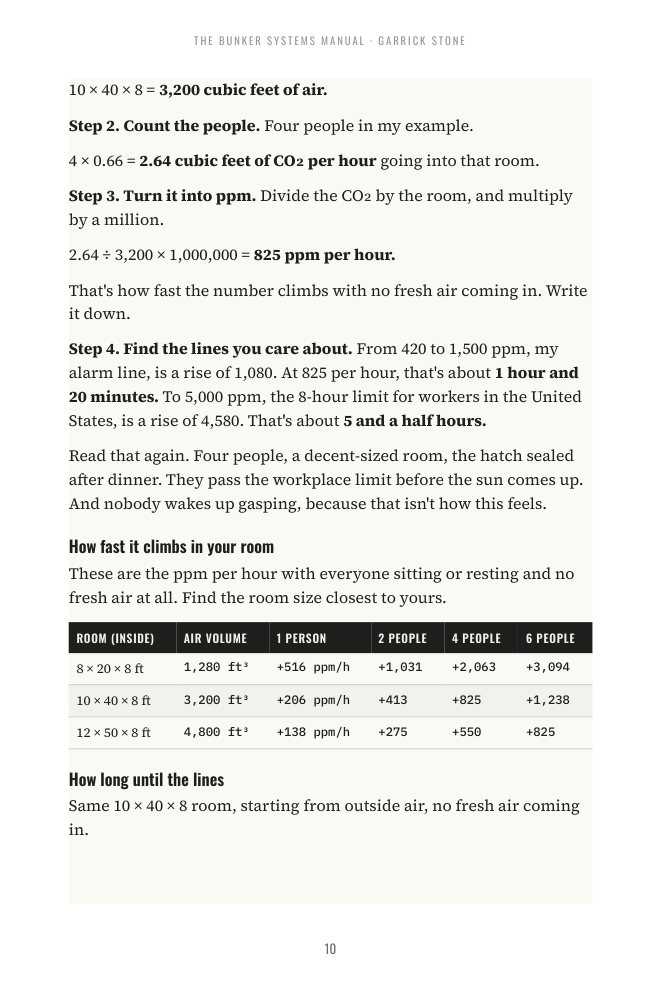
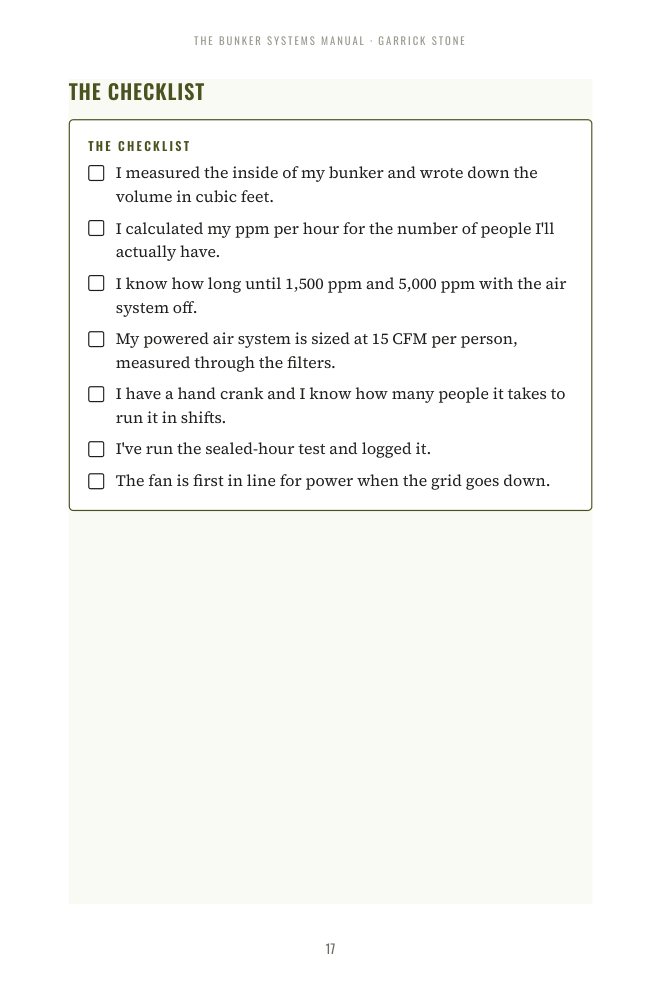
Four people in a 10 × 40 × 8 ft room with no fresh air: CO₂ climbs about 825 ppm an hour. Chapter 1 shows you the math for your room.
Two gallons per person per day, four people, one year. Chapter 4 shows where it goes, what it weighs and why storage alone runs out.
Four adults, five years of calories. That's not a shelf, it's a room. Chapter 13 shows why food has to become a system.
So you can find what you need with a flashlight in one hand.
This is exactly what opens on your phone, tablet or computer. Tap a page to enlarge it.


A fraction of what you'll find, with the page it's on.


I have a bunker under my own property. I built it, I tested it, and I've had to fix every system in it, some of them twice, because I got them wrong the first time.
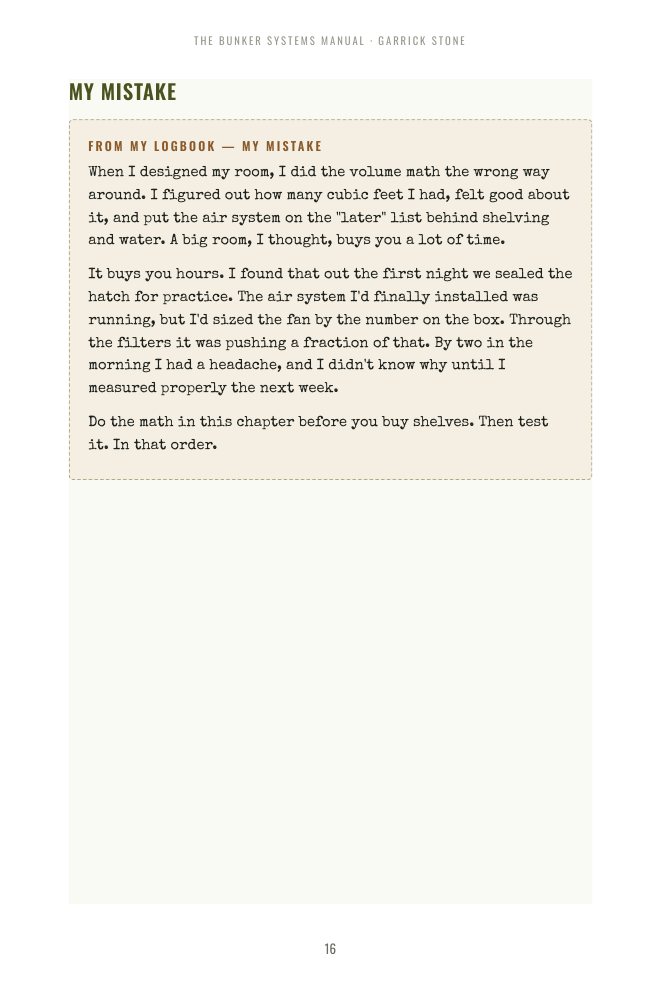
The first night we sealed the hatch for practice, I woke up at two in the morning with a headache I couldn't explain. The air gadget on the wall showed a nice, calm number. It didn't measure carbon dioxide at all. That's the night I stopped trusting anything I hadn't tested, and the night this manual really started.
I'm not selling you gear. There's no brand in this book you have to buy. I'm handing you the notes I wish someone had handed me before I poured the first yard of concrete.
I won't tell you where I live, and nobody outside my family knows where the bunker is. What I will tell you is everything I learned inside it.
If it doesn't change how you look at your bunker, send one email and you get every dollar back. You keep the files. I'd rather lose the sale than have you keep a manual you don't need.
Especially. Read it front to back before you spend another dollar. Chapters 1, 4 and 6 (air, water and power) decide how big everything else has to be. Getting those numbers right before you build is the cheapest thing you'll ever do for a bunker.
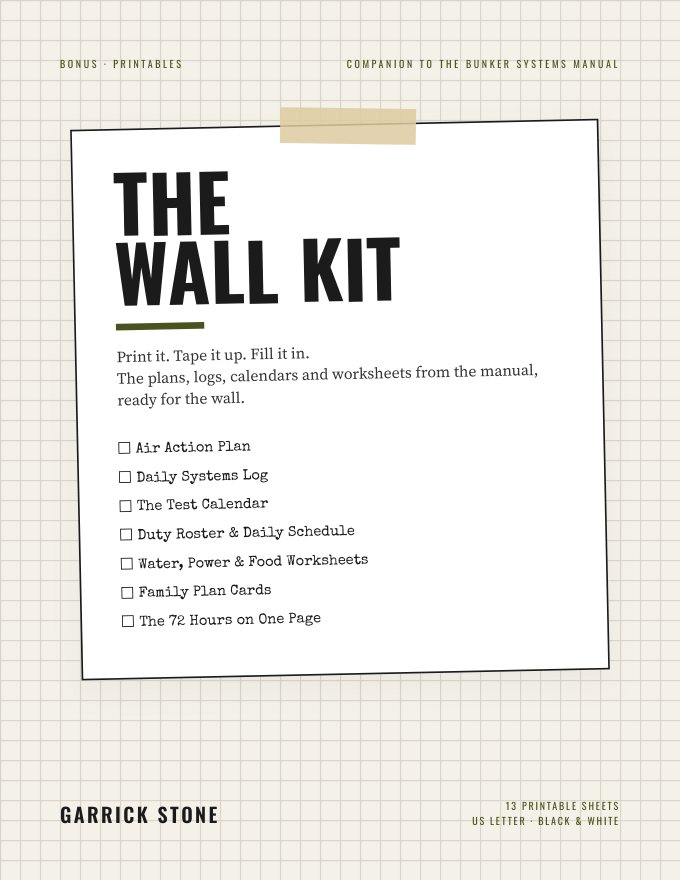
No. It's a PDF, delivered right after you pay. It opens on your phone, tablet or computer. Print it at home if you want paper, and print the Wall Kit for sure: it's made for the wall.
One wrong CO₂ monitor costs more than that. One bucket of ruined food costs about that. One generator that won't start, one wall of mold, one night with a headache you can't explain — the manual is cheaper than any one of the mistakes in it, and it covers all of them.
No. One payment, one time. No membership, no monthly anything.
No. Propane lines, gas connections, the electrical panel and structural work belong to licensed professionals, and the manual says so plainly. It tells you what to check, what to ask for and what a good job looks like.
No brands, no affiliate links, no "buy this kit." It tells you what kind of thing to look for and how to test it once you have it.
Seven days. One email. Every dollar back, and you keep the files.
Gear you haven't tested isn't gear. It's a guess. The manual turns every guess in your bunker into a number, a test and a backup.
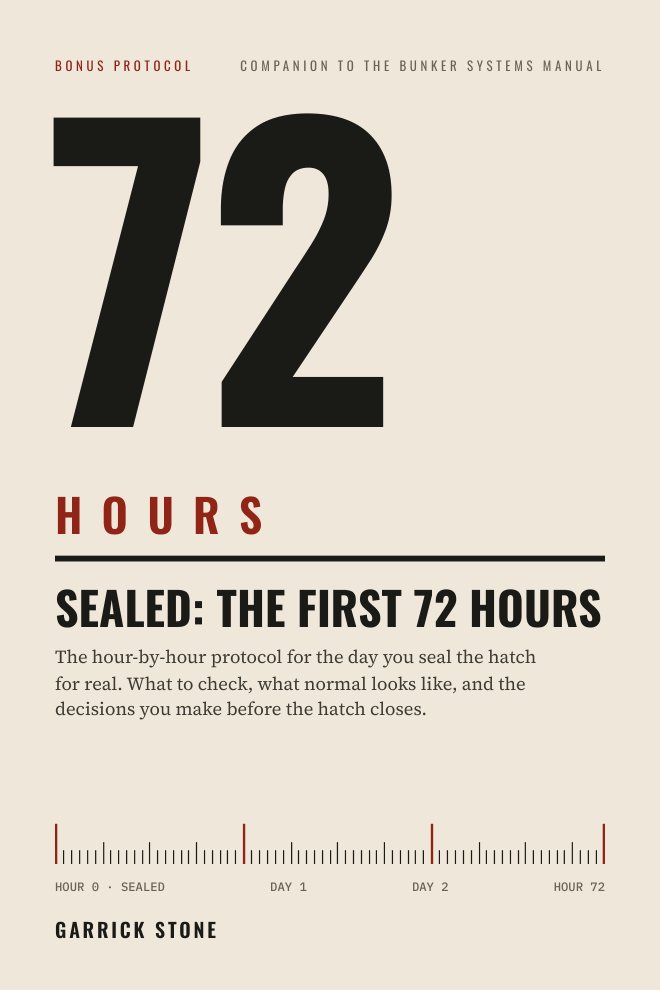
Get the Manual — $27153 pages + the 72-hour protocol + the Wall Kit